Talks and Conference Presentations
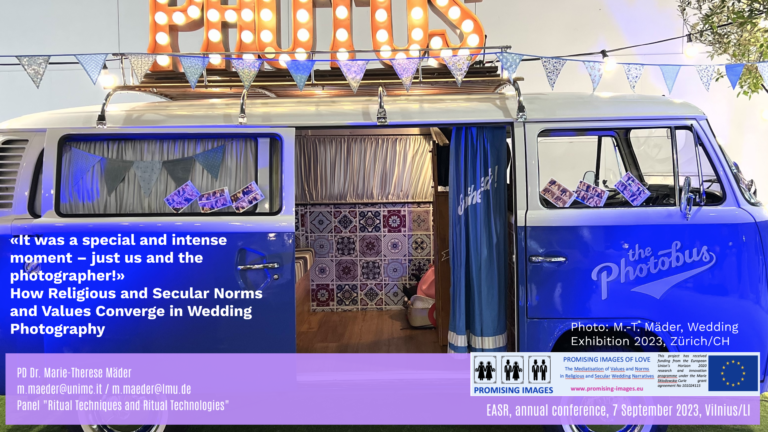
Annual Meeting of European Association in the Study of Religion, Vilnius/LT, 7 September 2023
«It was a special and intense moment – just us and the photographer!» How Religious and Secular Norms and Values Converge in Wedding Photography
Wedding photography provides its own stylistic norms and conventions that express specific values not only regarding representation but also in processes of production and reception. The current paper asks how do these stylistic norms and conventions express, confirm, adapt, and transform religious and secular values?
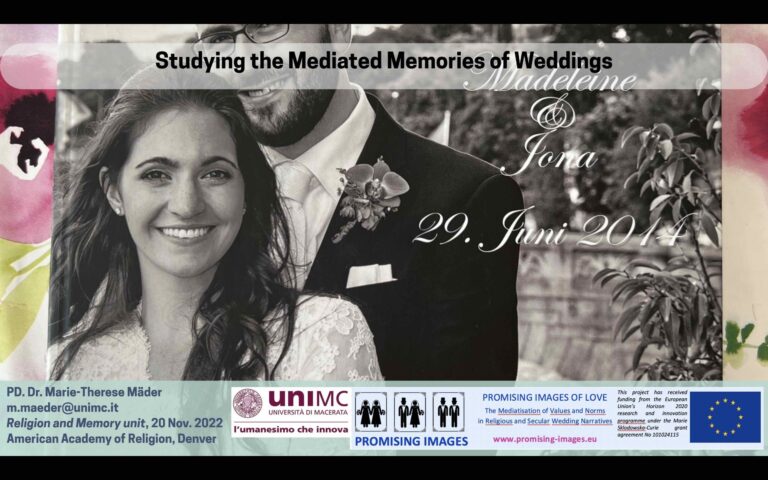
Annual Meeting of the American Academy of Religion, Denver/US, 19 November 2022
Studying the Mediated Memories of Weddings
The focus of the contribution is directed to the question of how do couples deal with their wedding photos and videos and what role do these media play to awakening memories of religious and secular dimensions of the event? I argue that the mediatization of weddings influences how a wedding is memorized and results in a partly standardization of memories of the event. The paper seeks to provide insights into an ongoing research into religion, memory, and mediatization by applying ethnographic field work and qualitative methods.
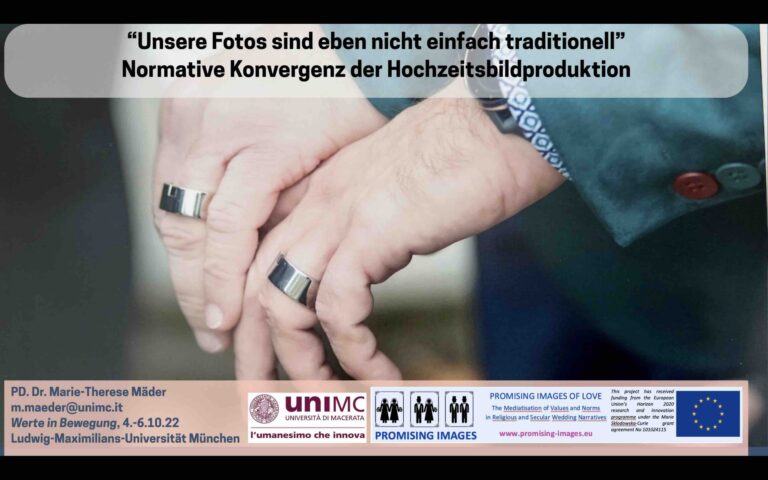
Tagung "Werte in Bewegung", Ludwig-Maximilians Universität München, 4. Oktober 2022
“Unsere Fotos sind eben nicht einfach traditionell”
Normative Konvergenz der Hochzeitsbildproduktion
Fotos und Videos vom „glücklichsten Tag seines Lebens“ zu besitzen, ist vielen Paaren ein grosses Anliegen. Was auffällt ist, dass die fotografischen Repräsentationen oftmals stark von binären Gendernormen geprägt sind. Dabei interagieren diese traditionellen Darstellungskonventionen, sowohl im säkularen wie auch in einem religiösen Umfeld, jedoch mit dem Wunsch seitens der Kundschaft und auch der Fotograf:innen nach einer individuellen und ganz persönlichen Note in der visuellen Gestaltung.
Die Präsentation geht anhand von Interviews und Hochzeitsbildern der Frage nach, wie Paare im Rückblick ihre eigenen Fotos bewerten. Was gefällt ihnen besonders an den Bildern? Was bedeuten diese für sie? Zu welchen Gelegenheiten schauen sie die Fotos an? Welche Geschichten sind damit verbunden?
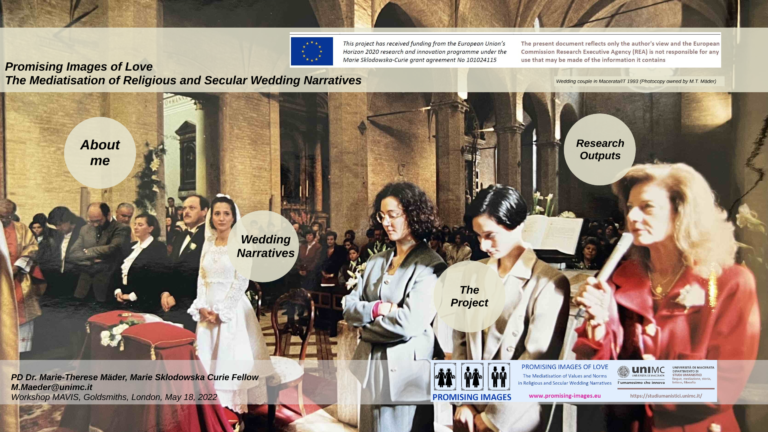
Goldsmiths, University of London, Visual Anthropology, 18 May 2022
The Visuals of Promising Images
The focus of the presentation is on the question how to produce a meaningful visual narrative based on the research question about the mediatisation of weddings. Footage of the field work that include interviews, wedding photos, and clips of wedding shows are shown during the presentation. The the methods to research wedding practices consist of participatory observation of weddings and narrative-biographical interviews with wedding photographers and married couples in Switzerland, Italy and Germany.
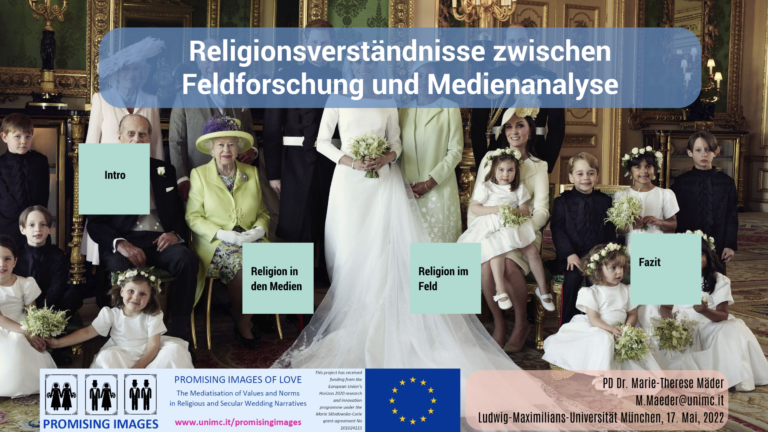
Ludwig-Maximilans-Universität Munich, 17 May 2022
Religionsverständnisse zwischen Feldforschung und Medienanalyse / Concepts of Religion between Field Research and Media Analysis
Die Präsentation arbeitet das Verhältnis von Religionskonzepten und methodischen Vorgehensweisen aus der Feldforschung aus. Dabei werden die vielfältigen Dimensionen von „Religion“ in der Erforschung unterschiedlicher medialer Quellen reflektiert, auf geeignete Ansätze aus der Forschungsgeschichte verwiesen und Strategien vorgestellt, wie diese Ansätze der aktuellen Forschungsfrage angepasst werden können.
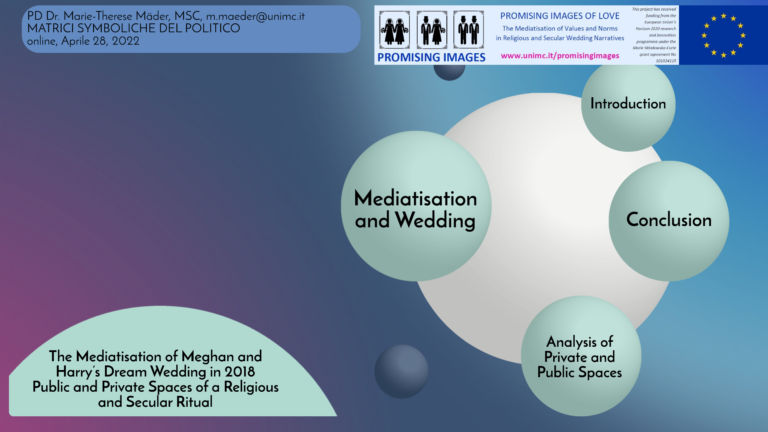
The Mediatisation of Meghan and Harry’s Dream Wedding in 2018
Annual meeting, Centro interuniversitario di studi sul simbolico, online, 28 April, 2022
What makes Meghan and Harry’s wedding so intriguing is the fact that the mass media coverage is combined with traditional-religious dimensions. Religion and the secular go hand in hand during wedding ceremonies and receptions. The talk discussed the following questions: Which private and public spaces does the mediatisation of the wedding create? What role does religion play in the mediatisation of the wedding? Is religion and the secular distinct from each other during the wedding event? How are these dimensions related to the public and private spaces constructed by the media?
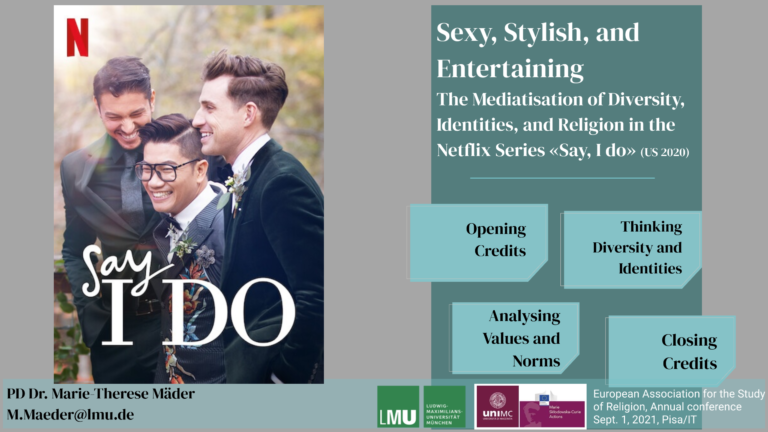
European Association for the Study of Religion (EASR), annual conference, Pisa/IT 1 September, 2021
Sexy, Stylish, and Entertaining. The Mediatisation of Diversity, Identities and Religion in the Netflix Series «Say, I Do» (US 2020)
With their professional experience as interior designer, chef, and fashion designer and Netflix’s funding, the host trio Jeremiah, Gabriele, and Thai organise and implement wishes for dream weddings in the reality romance series «Say, I do» (US 2020). The wedding show is sensitive in its inclusivity regarding race, gender and class evidenced in its choice of wedding couples and hosts. In the course of the first season a diverse group of couples (ethnically, economically and in sexual-orientation) are given their «dream wedding». Finally, the three gay hosts debate their experiences regarding relationships and weddings. I argue that on the one hand the mediatisation of the wedding ritual in which diversity becomes the norm is surprisingly traditional but religious symbols are shown with restraint. On the other hand the conservation of the ritual by the media provides orientation regarding identity: the couples identify as husbands and wives because of the traditional ritual.
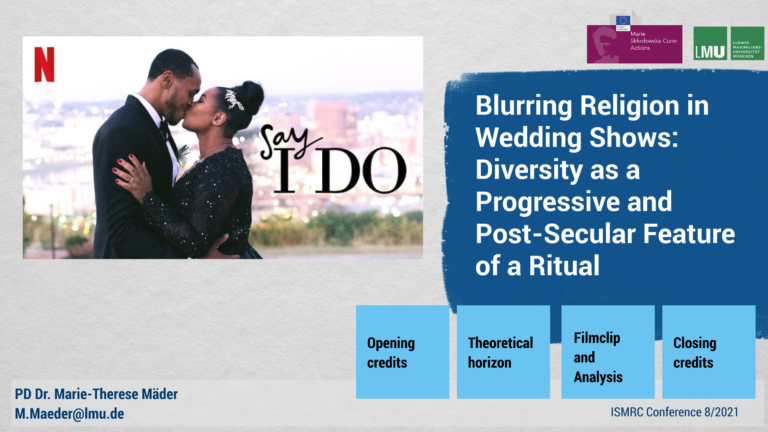
ISMRC annual Conference, online 04 August 2021
Blurring Religion in Wedding Shows. Diversity as a Progressive and Post-Secular Feature of a Ritual
For a long time, wedding TV shows have experienced great popularity . In most shows religion isn’t at the centre of the narrative but religious traces still remain. Do these shows prove that the mediatisation of a traditional religious ritual leads to the blurring of religion or at least its traditionally dominant role in the ritual? This contribution discusses the question by focusing on a case study, the reality show «Say, I do» (Netflix, US 2020, one season).
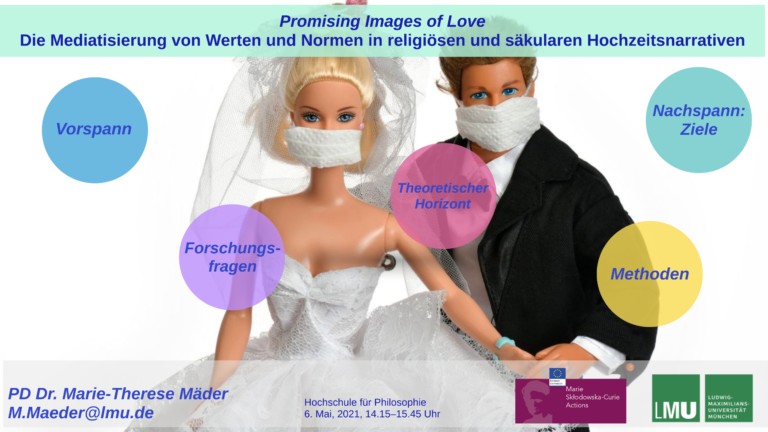
Hochschule für Philosophie, München 06 May 2021
Promising Images of Love. Die Mediatisierung von Werten und Normen in religiösen und säkularen Hochzeitsnarrativen
Yes, I do‘ and ‚Till death do us part‘ represent intimate promises between two – and yet implement a multitude of gender-related, social, cultural as well as economic norms and values. In contemporary wedding rituals, digital and electronic media play a central role, be it in the preparation, the ritual itself or afterwards. At issue are which norms and values contemporary media representations of religious and secular weddings in Europe convey.